
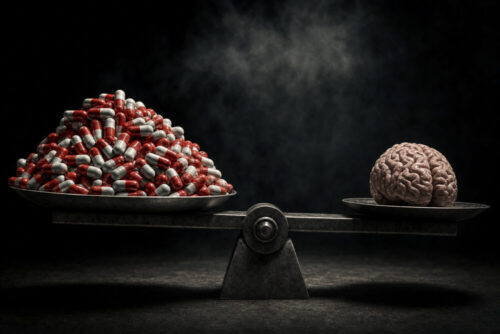
When “Feeling Better” Isn’t the Same as Being Healed
The recent buzz surrounding Health Secretary Robert F. Kennedy Jr.’s call to scrutinize antidepressant prescribing practices has ignited a firestorm of passionate, deeply personal responses from Americans across the country. Reading through the hundreds of comments on the New York Times coverage, one thing is undeniable: people are suffering. Real people, with real pain, who found something, anything, that seemed to help them get through the day.
We do not dismiss that suffering. Not for a moment.
But genuine compassion demands that we ask the harder question, the one the psychiatric industry has been remarkably reluctant to answer honestly: What if the relief millions of people feel isn’t coming from correcting a chemical imbalance in the brain, because no such imbalance has ever been proven to exist?
The Myth That Launched a Trillion-Dollar Industry
For decades, Americans have been told a simple, clean story: depression is caused by low serotonin in the brain. SSRIs fix that imbalance. End of story.
The problem? That story was never true and the people behind the lie have now admitted it.
In 2022, a landmark umbrella review published in Molecular Psychiatry by Dr. Joanna Moncrieff and colleagues at University College London examined decades of research and concluded there is no consistent evidence that depression is caused by low serotonin levels or serotonin activity. The “chemical imbalance” theory, the review found, is not supported by the science.
This was not a fringe publication. This was a peer-reviewed meta-analysis of the most comprehensive body of serotonin research ever assembled.
Dr. Moncrieff was direct: “Many people take antidepressants because they have been led to believe they have a chemical imbalance. This is not supported by evidence.”
This is not a new concern, either. As far back as 2005, Dr. David Healy, one of the world’s most cited psychopharmacologists and a former Secretary of the British Association for Psychopharmacology, warned that the serotonin hypothesis was a marketing construct, not a medical finding. In his extensively documented work, he traced how pharmaceutical companies built a blockbuster drug category on a theory they knew was unproven.
In 2008, Dr. Irving Kirsch of Harvard Medical School published his landmark analysis of FDA trial data, data that had been kept from the public, in PLOS Medicine. His finding: antidepressants outperform placebo by a margin so small it fails to meet the threshold for clinical significance in all but the most severely depressed patients. For mild to moderate depression, the category into which the vast majority of prescriptions fall, the drugs perform no better than a sugar pill.
The Placebo Effect Is Real and Powerful
Here is where we must speak directly and respectfully to the many people who shared their stories in that comment section; people who said SSRIs gave them their lives back, helped them function, ended their nightmares, lifted the fog.
We believe you. Your experience is real. Your relief is real.
But relief from a treatment is not the same as proof that the treatment is working the way we’ve been told it works. The placebo effect is one of the most powerful and well-documented phenomena in all of medicine. It is not “imaginary.” It is a genuine neurobiological response. Studies have shown placebo treatments triggering measurable changes in brain chemistry, pain perception, immune function, and mood.
When someone takes an SSRI and feels better within weeks, there is no way, without a controlled trial, to know how much of that improvement came from the drug’s chemistry, how much came from the powerful expectation of relief, how much came from finally being heard by a doctor, and how much came from the simple passage of time. In mild-to-moderate depression, research strongly suggests the answer is: mostly the latter three.
This is not an attack on people who feel their medications help them. It is a call to be given the full truth so that each person can make a genuinely informed choice.
What Is Informed Consent And Are We Actually Getting It?
Informed consent is the bedrock of ethical medicine. Before any treatment, a patient has the legal and moral right to know: What does this drug actually do? What does the science actually show? What are the risks, including risks that may be long-term or permanent?
Based on the evidence available today, a fully informed conversation before an SSRI prescription would have to include the following:
- The serotonin deficiency hypothesis has been scientifically refuted. We do not know the precise mechanism by which these drugs affect mood, if at all.
- For mild to moderate depression, clinical trial data shows antidepressants are not significantly more effective than placebo in the majority of patients. (Kirsch, PLOS Medicine, 2008; Turner et al., New England Journal of Medicine, 2008.)
- Withdrawal can be severe and prolonged. The psychiatric establishment long claimed discontinuation symptoms were mild and short-lived. Research by Dr. Mark Horowitz and Dr. John Read, published in Addictive Behaviors (2019), found that over half of people who try to stop antidepressants experience withdrawal symptoms, and for nearly half of those, the symptoms are severe. Many people who believe their depression has “returned” are in fact experiencing withdrawal a critical distinction that changes the entire picture of long-term “need.”
- Post-SSRI Sexual Dysfunction (PSSD), numbness and sexual dysfunction that persist after stopping the drug, is a recognized condition documented in published literature and now acknowledged by the European Medicines Agency. It can be permanent.
- The FDA’s own black box warning notes an increased risk of suicidal thinking in patients under 25. This is not a controversy, it is on the label.
How many of the millions of people currently taking SSRIs were given all of that information before they filled their first prescription? Based on the comments in the Times alone, where multiple people describe receiving a prescription after a 10-question computer questionnaire with a general practitioner, the answer is: very few.
A Note to Those Who Feel These Drugs Have Helped Them
You are not wrong to have sought help. You were right to do so.
But you were owed the complete truth before you made that decision, and in most cases, you were not given it. You were told your brain had a chemical imbalance. You were not told that claim has never been scientifically validated. You were told the drugs would correct that imbalance. You were not told that the clinical trial data, even the data the FDA reviewed, shows the benefit over placebo to be marginal for most people.
You deserved better than that.
And the people who may be sitting in a doctor’s office this week; anxious, exhausted, desperate for relief, deserve better than that, too. They deserve a full and honest conversation about what we know, what we don’t know, what the risks are, and what the alternatives are.
That conversation, true informed consent, is not a threat to mental health care. It is mental health care.
The question was never whether people are suffering. They are. The question is whether we are brave enough to insist they be told the whole truth about the treatments being offered to them and whether we are willing to build a system that offers them something better.
The Citizens Commission on Human Rights (CCHR) is a nonprofit mental health watchdog organization dedicated to investigating and exposing psychiatric violations of human rights. CCHR does not oppose genuine mental health care; it advocates for safe, effective, and fully informed treatment options for all people.

0 Comments