

Last week Florida State University announced a $500,000 federal suicide prevention grant, matched by the university for a $1 million initiative. The plan is to expand screening, crisis response and referrals, and to train at least 4,000 students, employees and campus partners by year four (FSU News).
No one doubts the good intentions behind it. But good intentions are not results. Before another dollar is spent, students, parents and lawmakers deserve an honest answer to a simple question: is any of this working?
The evidence says no.
Follow the money
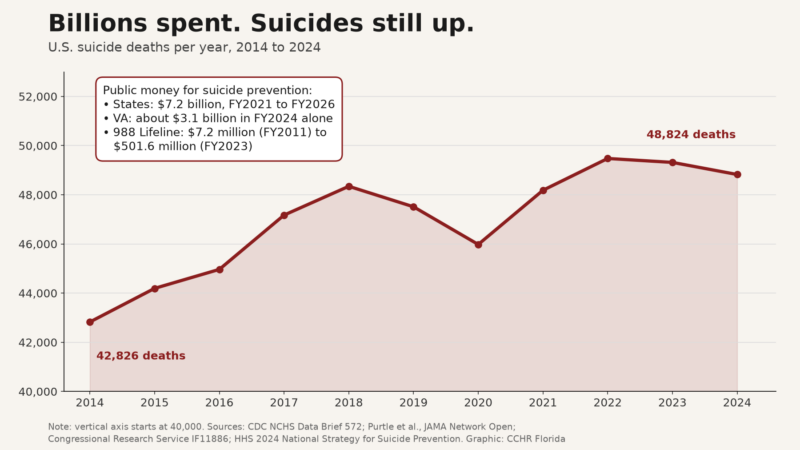
Suicide prevention has become a large and fast-growing line item in public budgets. Between fiscal years 2021 and 2026, state budgets set aside $7.2 billion specifically for suicide prevention and crisis services. Average per-resident spending rose more than sixfold, from $1.05 in 2021 to $6.55 in 2025 (Purtle et al., JAMA Network Open; NYU). Over FY2022 through FY2024, the Department of Veterans Affairs obligated another $8.7 billion for suicide prevention treatment and outreach. That is roughly $3.1 billion in FY2024 alone (Congressional Research Service).
Those two sources add up to **nearly $16 billion in just a few years**. And that total leaves out a great deal. It does not count the $1.6 billion SAMHSA used to build and run the 988 Lifeline (GAO). It does not count SAMHSA’s other suicide prevention grants, CDC programs, NIH research, the Defense Department, school districts or Medicaid. Federal investment in the national crisis line alone went from $7.2 million in FY2011 to $501.6 million in FY2023 (HHS National Strategy).
Now look at the results
In 2014, 42,826 Americans died by suicide. In 2024, the number was 48,824. The age-adjusted rate rose from 13.0 to 13.7 per 100,000 and has been essentially flat since 2017 (CDC). The 2024 rate remains 32% higher than in 2000 (AFSP, citing CDC).
Our young people have fared worse. Among Americans aged 10 to 24, the suicide rate climbed 62% from 2007 to 2021. Among children aged 10 to 14, it tripled between 2007 and 2018 (CDC).
Veterans, who receive the most concentrated prevention spending in the country, tell the same story. The veteran suicide rate rose from 24.3 per 100,000 in 2001 to 36.4 in 2024. In 2024, 6,488 veterans died by suicide (VA). Divide the VA’s FY2024 suicide prevention budget by that number and it comes to roughly $480,000 for every veteran lost.
If any other public program spent this much and produced these outcomes, we would demand an audit.
The research has been warning us
This is not just my opinion. In 2017, Scientific American reported that suicide risk assessment “doesn’t work.” Ninety-five percent of patients labeled “high risk” do not die by suicide, while half of all suicides come from patients labeled “low risk.” Researchers even warned that these assessments may be “paradoxically, increasing the risks of suicide” (Scientific American).
Gatekeeper training, the centerpiece of FSU’s plan, raises knowledge and confidence, but those gains fade over time (BMC Public Health). A network meta-analysis found that school gatekeeper programs did not reduce suicidal thoughts or behaviors among young people (APA PsycNet). The VA’s own clinical guideline says the evidence is insufficient to recommend for or against standalone gatekeeper training (VA).
Some programs appear to cause harm. In a randomized trial of more than 12,000 English schoolchildren, two classroom mental health awareness programs, one of them a suicide prevention curriculum, were followed by increased emotional difficulties a year later. The researchers recommended the suicide program not be used in English secondary schools (UK Department for Education). Psychologists have proposed that awareness campaigns may lead some young people to interpret ordinary distress as a disorder, with self-fulfilling results (Foulkes and Andrews).
Where does the prevention pipeline lead? All too often, to a psychiatric ward or a prescription. Yet a meta-analysis of 100 studies found that in the first three months after psychiatric discharge, the suicide rate is about 100 times the global rate (JAMA Psychiatry). A 2025 analysis identified prior psychiatric hospitalization as one of the strongest statistical risk factors for later suicide (Tai, Large et al.).
Internationally, a study of 28 countries could not find any component of national suicide prevention strategies associated with lower suicide rates (University of Edinburgh). The Zero Suicide model, adopted by health systems worldwide, has been called “style over substance,” with “a dearth of published evidence” that it reduces suicide (British Journal of Psychiatry).
More screening, more drugs
As prevention spending has grown, so has the number of Americans on psychiatric drugs. Antidepressant use among Americans 12 and older rose nearly 65%, from 7.7% in 1999 to 2002 to 12.7% in 2011 to 2014 (CDC). Among adolescents and young adults, monthly antidepressant dispensing rose 66% from 2016 to 2022. For girls aged 12 to 17, it accelerated about 130% faster after March 2020 (Pediatrics).
These are the same young people the FDA warns about. Every antidepressant carries a boxed warning that these drugs “increased the risk of suicidal thoughts and behavior in children, adolescents, and young adults” in short-term studies (FDA label via DailyMed).
Rising prescriptions and stubborn suicide rates do not prove that one causes the other. But a system that screens young people, labels them and routes them toward drugs carrying the government’s strongest warning for suicidal thinking in their age group has a lot to answer for. Parents are rarely told any of this before the screening begins.
What students, parents and lawmakers should demand
- Students: Ask your school what evidence shows its program reduces suicide, not just “awareness.” Ask what happens to your information after a screening.
- Parents: Insist on written, informed consent before any mental health screening or survey of your child. Ask for the FDA warnings on any drug proposed for your child, and ask about non-drug options and medical causes of distress first.
- Lawmakers: Tie every suicide prevention dollar to measured reductions in deaths and attempts, with independent evaluation and public reporting. Stop funding programs that cannot show results. Require full disclosure of drug risks to patients and parents. Invest in what the evidence does support, such as limiting access to lethal means (House testimony, Craig Bryan), along with the things that make life worth living: family, mentors, physical health, purpose and real-world support.
We owe the families who have lost someone more than another press release about another grant. We owe them results. After nearly $16 billion, the burden of proof belongs to those asking for more.
If you or someone you know is struggling, please reach out to someone you trust. No one should stop or change a prescribed medication without speaking with a qualified medical professional, as stopping abruptly can be dangerous.
Diane Stein is President and CEO of CCHR Florida, a Clearwater-based nonprofit that advocates for mental health patient rights and informed consent.
A note on the figures
The “nearly $16 billion” combines two non-overlapping public sources: $7.245 billion explicitly allocated in state budgets for suicide prevention and crisis services, FY2021 to FY2026 (JAMA Network Open), and $8.72 billion in VA suicide prevention treatment and outreach obligations, FY2022 to FY2024 (CRS). The VA FY2024 figure is an estimate. State budget amounts may include some federal pass-through funds. Federal 988, SAMHSA, CDC, NIH, DoD, school district and Medicaid spending are excluded, so the true total is higher.
0 Comments