Helping children in crisis and reducing youth suicide are two areas of concern that everyone agrees must be addressed.
Unfortunately, the solutions of the past (screenings, more funding, the Baker Acting of kids) have not worked.
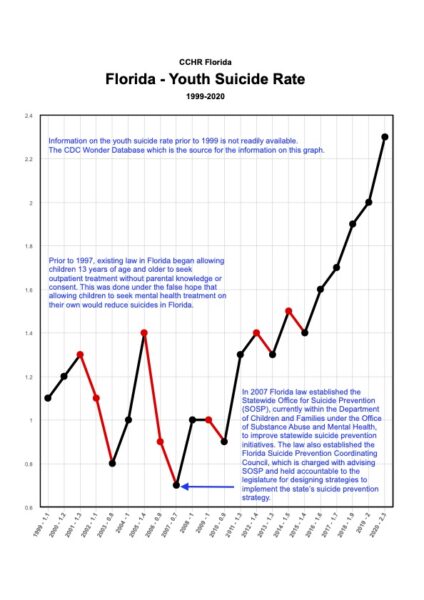
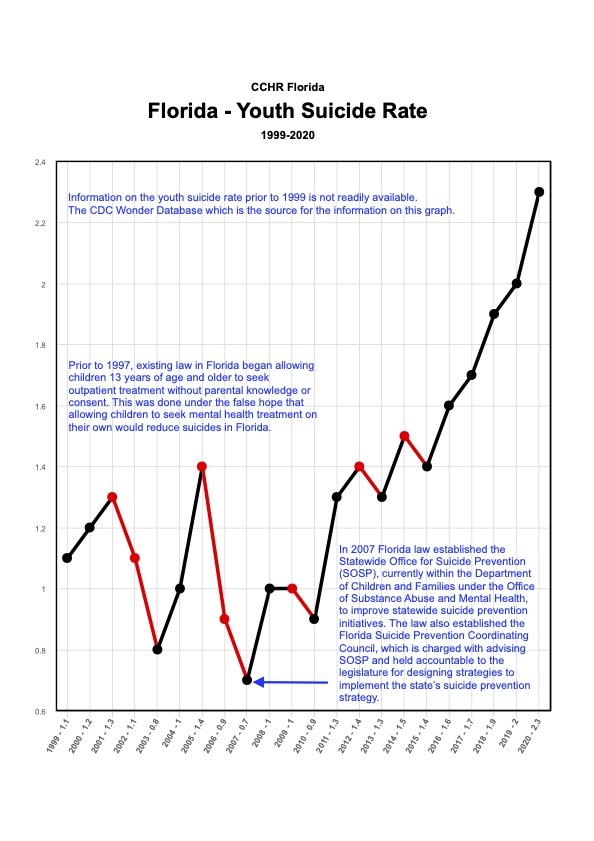
Prior to 1997, existing law in Florida began allowing children 13 years of age and older to seek outpatient treatment without parental knowledge or consent. This was done under the false hope that allowing children to seek mental health treatment on their own would reduce suicides in Florida. This did not happen.
Then in 2007 Florida law established the Statewide Office for Suicide Prevention (SOSP), currently within the Department of Children and Families (DCF) under the Office of Substance Abuse and Mental Health, to improve statewide suicide prevention initiatives (§ 14.2019).
The law also established the Florida Suicide Prevention Coordinating Council (SPCC), which is charged with advising SOSP and held accountable to the legislature for designing strategies to implement the state’s suicide prevention strategy (§ 14.20195).
This too did nothing to stop the ever-climbing youth suicide rate.
However, a few changes that have occurred over the last few years appear to be having a significant impact on youth suicides in Florida.
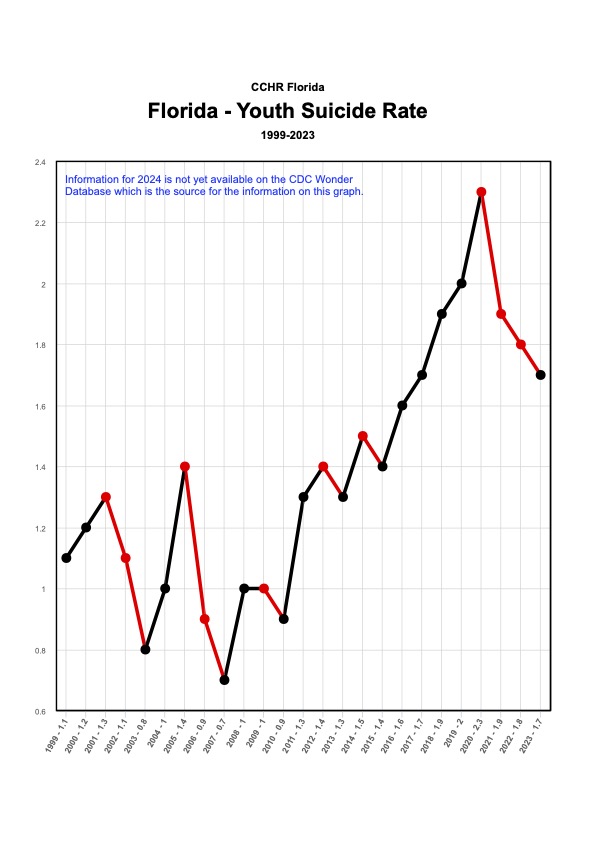
Florida passed legislation in 2021 which clearly states that a parent has the right to direct the mental health of their children. That same year legislation was also passed that put in requirements to contact a parent before a child is taken into custody for an involuntary psychiatric examination with the intention of giving a parent the right to help their child in a time of crisis.
Additional changes were made in 2022 concerning parental rights in education and these changes resulted in Florida prohibiting the use of mental health industry based social emotional learning in schools.
Since these changes were made, the youth suicide rate is finally beginning to decline and the rate of children being taken into custody involuntarily for psychiatric examination is also finally declining.
Why are schools involved in children’s mental health in the first place?
As administrators, legislators and parents in the United States try to sort out how to help children, schools and parents find themselves in a power struggle. With schools sidestepping parents in mental health treatment and curriculum, creating the best, most supportive community possible without violating parental rights is critical.
Across the country, police and other authorities have been forcibly restraining elementary-aged kids and even making arrests, handcuffs and all. Some of those children are sent to mental health facilities and sedated before their parents can consent.
Even if children weren’t being improperly removed from schools, some academic facilities are covertly enrolling children in mental health programs. Parents are left in the dark about what those programs teach, and concerns arise when they find mental health topics included.
Other tools, like apps to track kids’ feelings, are similarly scrutinized for potential privacy violations. Parents and advocacy groups are also concerned that children’s attempts to be open about mental health might backfire. A Scientific American article by two psychiatrists reported that studies on the last 40 years of suicide risk research indicate the mental health industry is not only “not very good” at predicting suicide risk but that the process itself might increase the likelihood of suicide.
Teachers, administrators, and other school personnel spend significant amounts of time with children throughout the day, so they are well-positioned to notice symptoms of mental distress or abuse. This has led to a significant uptick in school-based mental health centers.
Schools must take care not to adopt extremist ideology like that of Chester Pierce, a psychiatrist who in 1973 said in an address to the Childhood International Education Seminar:
“Every child in America entering school at the age of five is insane because he comes to school with certain allegiances to our founding fathers, toward our elected officials, toward his parents, toward a belief in a supernatural being, and toward the sovereignty of this nation as a separate entity. It’s up to you as teachers to make all these sick children well – by creating the international child of the future.”
Although school officials might genuinely care about protecting children, it is parents who are responsible for their children and are most familiar with their behaviors and circumstances. Of course, schools must take care to report cases where parents or guardians might pose a risk to children, but ultimately, parents have the right to direct the mental health of their children, not schools.
The loopholes that exist in Florida law which allow a child to be treated by a mental health professional without parental consent need to be closed.